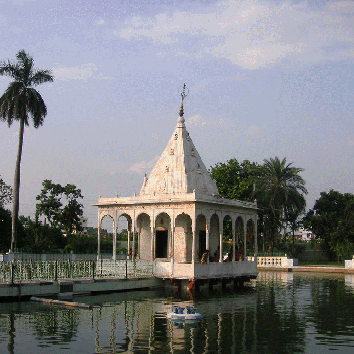
Gaya is an old city, with a recorded history going back to the sixth century BCE when the savvy Gautama Buddha accomplished illumination at Bodh Gaya, 16 km (9.9 mi) from the cutting edge city, and turned into the Buddha.
Indeed, even before this time, Gaya was a position of journey for individuals from around the globe. The notoriety of old Gaya got from the record in the Ramayana of the god Rama coming here to the banks of Phalgu River (called the Niranjana), joined by his better half and more youthful sibling, to offer pind-daan for their dad Dasharatha, for the moksha of his soul. In the Mahabharata, Gaya is alluded to as Gayapuri.
History of Gaya
Gaya prospered in the Maurya Empire (321– 187 BCE), which ruled from the city of Pataliputra (neighboring present day Patna) over a region that stretched out past the Indian subcontinent. Amid this period, Gaya saw the ascent and fall of numerous administrations in the Magadha area, where it possessed an essential place in social history over somewhere in the range of 2,400 years between the sixth century BCE and the eighteenth century CE.
The city's social noteworthiness started with the tradition established by Sisunaga, who practiced control over Patna and Gaya around 600 BCE. Bimbisara, fifth ruler of the tradition, who lived and administered around 519 BCE, had anticipated Gaya to the external world. Having accomplished a vital place ever of, the territory encountered the impact of Gautama Buddha and Bhagwan Mahavir amid the rule of Bimbisara. After a concise period under the Nanda administration (345– 321 BCE), Gaya and the whole Magadha locale went under Mauryan rule. Mauryan Emperor Ashoka (272– 232 BCE) grasped and advanced Buddhism. He visited Gaya, and manufactured the primary sanctuary at Bodh Gaya to honor the Buddha's achievement of preeminent enlightenment.
The time of Hindu revivalism started with the Gupta Empire amid the fourth and fifth hundreds of years CE. Samudragupta of Magadha brought Gaya into the spotlight, making it the capital of Bihar area amid the Gupta Empire.
In 750 CE, Gaya turned into a piece of the Pala Empire, under the standard of its organizer, Gopala. It is trusted that the present sanctuary of Bodh Gaya was worked amid the rule of Gopala's child, Dharmapala. In the twelfth century CE, Gaya was attacked by Muhammad Bakhtiyar Khilji of the Ghaznavid Empire. By 1557, it had progressed toward becoming piece of the Mughal Empire, and stayed under its capacity until the Battle of Buxar and the start of British standard in 1764. Gaya, alongside different parts of the nation, picked up its autonomy in 1947.