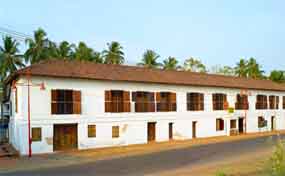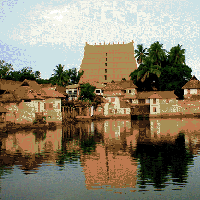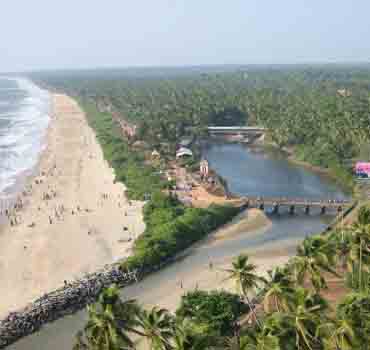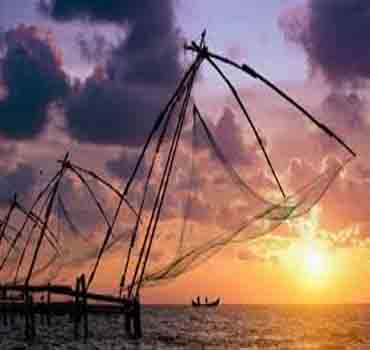
Kannur was a critical exchanging focus in the twelfth century, with dynamic business associations with Persia and Arabia. It filled in as the British military central station on India's west drift until 1887. Related to its sister city, Tellicherry, it was the third biggest city on the western shoreline of British India in the eighteenth century after Bombay and Karachi. The cutting edge town is alluded to as Kannur Town. Kannur, as a locale and encompassing zones, were generally led by the celebrated Kolathiri rajas (lords). At the point when the territory of Kerala was shaped the locale took the name Kannur since the managerial workplaces were built up here.
History of Kannur
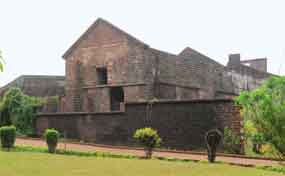
Kannur Cantonment is one of the 62 military cantonments in the nation and is the central command of the Defense Security Corps and Territorial Army's 122 Infantry Battalion (some portion of the Madras Regiment). The Indian Naval Academy (INA) is 35 km north of Kannur City. It is Asia's biggest and the world's third biggest maritime institute. An Indian Coast Guard Academy has gotten endorsement to be worked at Kannur. This institute will be based on the banks of Valapattanam River at Irinave, east of Azhikkalof Kannur was under Kerala's solitary Muslim Royalty called the Arakkal and this territory is as yet known as City. St. Angelo Fort was worked in 1505 by Dom Francisco de Almeida, the main Portuguese Viceroy of India. The Dutch caught the fortress from the Portuguese in 1663. They modernized the fortification and manufactured the bastions Hollandia, Zeelandia and Frieslandia that are the real highlights of the present structure. The first Portuguese stronghold was pulled down later. A canvas of this stronghold and the angling ship behind it very well may be found in the Rijksmuseum Amsterdam. The Dutch sold the post to lord Ali Raja of Arakkal in 1772. Amid the seventeenth century, Kannur was the capital city of the main Muslim Sultanate in Kerala, known as Arakkal.[5] Then the British vanquished it in 1790 and utilized it as one of their significant military stations on the Malabar Coast. Amid the British Raj, Kannur was a piece of the Madras area in the North Malabar District. The guerrilla war by Pazhassi Raja, the leader of Kottayam area, against the British had a tremendous effect in the historical backdrop of Kannur. Changes in the financial and political segments in Kerala amid the underlying many years of twentieth century made conditions friendly for the development of the Communist Party. Expansion of English instruction started by Christian evangelists in 1906 and later conveyed forward by government, resistance for wearing a fabric to cover upper parts of body, introducing an icon at Aruvippuram in 1888, Malayali Memorial in 1891, foundation of SNDP Yogam in 1903, exercises, battles and so on progressed toward becoming variables accommodating to quicken changes in Kerala society amid a brief span. Developments for freedom from the provincial principle of British government and battles propelled by these developments developed with them. Soon, thoughts regarding communism and Soviet Revolution came to Kerala. Such thoughts got spread in Kerala through crafted by Swadeshabhimani Ramakrishna Pillai, Sahodaran Ayyappan, P. Kesavadev and others. By the start of the 1930s some other helpful improvements were occurring. Imperative among them was Nivarthana Agitation in Travancore. That was the interest of individuals stifled so far as untouchables and flimsier areas for support in government. This conveyed to the front line battles like relative portrayal in government and reservation of employments. This conferred another eagerness among persecuted masses.