

Arna Jharna: The Desert Museum Jodhpur TRAVEL GUIDE
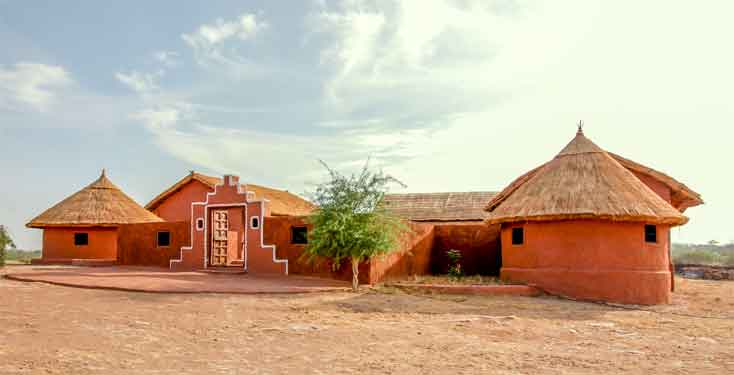
Arna-Jharna: The Desert Museum is an endeavor to rethink what a historical center could be. Rather than being encased in a crate, it praises the open spaces of the desert, including its greenery, as a major aspect of a bigger comprehensive investigation of the historical center as a position of learning. Imagined by the late Komal Kothari, one of India's driving folklorists and oral students of history, the Arna-Jharna Museum can be depicted as a procedure of intuitive learning encounters connected to conventional information frameworks. Arranged on a relinquished sandstone mine encompassed by cruel and dry territory, the Arna-Jharna museum, with its very own water-gathering framework, has changed the cavity of the mine into a lake which has turned into the frequent and settling ground of feathered creatures, prominently the peacock. The scene with its sedimentary shake arrangements stays brutal, yet the dirt has been sustained to suit a rich biodiversity of indigenous grasses, prickly plant, khejri, kerber, rohira, kumquat. The museum is most outstandingly known for its remarkable accumulation of floor brushes gathered from various parts of Rajasthan. More than 100 kinds of floor brushes are shown tossing light on the different sweeper making networks of Rajasthan and their connection to the encompassing biodiversity.
How to Reach Arna Jharna The Desert Museum
Around 23 km from Jodhpur, the course to the historical center passes tourist spots like the Machiya Safari Park, the Kaylana Lake, the Kala Ghora sanctuary in the Barli town. You will achieve the Anna-Jharna-Phanta, where the north-west street heads towards Jaisalmer and the south-west street will lead you to the museum.
Time to visit Arna Jharna The Desert Museum
8am – 6pm
Arna Jharna The Desert Museum Location
Places to visit in Arna Jharna The Desert Museum
Arna-Jharna: The Desert Museum of Rajasthan is an endeavor to rethink what a gallery could be. Rather than being encased in a crate, it commends the open spaces of the desert, including its widely varied vegetation, as a major aspect of a bigger all-encompassing investigation of the historical center as a position of learning. Imagined by the late Komal Kothari, one of India's driving folklorists and oral students of history, the Arna-Jharna Museum can be portrayed as a procedure of intuitive learning encounters connected to customary information systems.
The Desert Museum Rajasthan epitomizes two standards in its rationality and practice: One, the museum can be viewed as a research center of the common, a proving ground of every one of those fundamental structures of life that encourage the specialty of survival in the desert. Two, the museum commends the way that the 'society' is contemporary. The alleged 'customary networks' clutching aptitudes and methods of information from prior occasions are additionally part of a dynamic, evolving present. So as to test its standards in a thorough and natural way, the Museum commits the initial three years of its reality to a solitary article: the floor brush. It isn't the all-encompassing presentation of several floor brushes from the most distant corners of Rajasthan that is the need here. Rather than ethnic exhibition, the emphasis is on the interrelationships of the sweeper to a wide assortment of settings: regular assets, nearby/neighborhood methods of floor brush making/the lives of sweeper producers from underestimated standing gatherings/the legends convictions and images encompassing the floor brush/the economy of the floor brush. Why the Broom!
Unnoticeable, minimal, if not imperceptible, concealed in corners, covered up under the bed, a floor brush would give off an impression of being without any esteem. Surely, it's anything but a workmanship object that one would connect with a historical center. But then, this is absolutely the item that Komal Kothari featured so as to start his examination of the historical center. What appears to be absolutely immaterial, if not expendable, is the thing that holds the world together in its ability to clean and request space. As we investigate the universe of the floor brush, we are properly lowered by the vistas of human and social learning that it is equipped for uncovering. Most importantly, the floor brush carries us into contact with grasses, plants, and other herbal assets. In rustic Rajasthan, town ladies make their own floor brushes from whatever is accessible in their condition - leaves, twigs, bushes, and waste material. Most of the floor brushes in our show center around these are libbed sweepers, vouching for the inventiveness and imagination of nearby information. Furthermore, we additionally center around floor brushes made by expert sweeper making networks that are sold in business sectors. There is no lack of assortment here fit as a fiddle, size, and material, which are firmly identified with the surface of specific surfaces. We have gathered in excess of a hundred sixty floor brushes from various parts of Rajasthan. The number could develop. Be that as it may, the spotlight won't be on amount, which would advance the ethos of gathering objects. We are progressively worried about building up a comprehension of the connection between the biodiversity of the desert and the lives of individuals possessing and enduring its brutal, yet supporting, condition.
© Copyright 2018 Design ByIndia Easy TripAll Rights Reserved